Sophia's Peace Work

Sunday, May 24, 2009

"I hate Iraq"

"Excuse me, can you tell me where the exit is?" the teenage boy asked me. We were in the park where I go to run at night and I pointed him in the right direction knowing full well that his questions was simply a ruse to initiate a conversation with me.

Soon he was sitting on the cement park bench next to me. Ah, well, I had intended to sit quietly for a few minutes to let my heart settle down after a 30 minute run in the park, but that was not to be.

Rasheed was rather atypical in that his English was excellent but sadly rather par for the course when he told me within a minute of sitting down how much he hated Iraq. I asked him why repeatedly and the best answer I could get out of him was that at his age (18) in American, he would already have a girl friend but that wasn't possible for him in Iraq.

Ah teenage angst. I've seen that here before, even the older men suffer from it.

Where does the problem lie, I asked him. In the girls, he told me. They refuse to have relationships with the boys (from what I've seen about how the boys behave, I really can't say that I blame the girls that much ... they risk a lot more than the boys do in taking on an Iraqi boyfriend).

I informed him that going to America might not solve all his problems. But he insisted that everything in America was better and that even the country was more beautiful. I tried to convince him that I had seen a lot of Iraqi Kurdistan and that there are places here of equal beauty but he would hear none of it.

Like nearly every other young Iraqi I've met, he was just bidding his time until he could leave.

Wednesday, May 20, 2009

The New Pig Hunt

H1N1 has put the scare into a lot of people here in Iraq and there have been a flurry of newspaper articles about the threat of "Swine Flu" as it is mistakenly known. Most of these articles include statements by boasting government officials on how they have the problem in hand, no cases have been found in Iraq, etc. etc. etc. But many of them end with a statement about activities to cull or eradicate Wild Boar (Sus scrofa) in Iraq.

Wild Boar can be found in the marshes and along many of the rivers but also in grass and woodlands. Many Boar are considered a nuisance to farmers because they have been known to dig and root in farmers fields and eat the cultivated plants. Many are killed for this reason and in the Mesopotamian Marshlands of southern Iraq Boar hunts are an activity with a long history (ie: to Sumerian times). Unfortunately for the Wild Boar, this new concern over the H1N1 virus, has led to another, if erroneous reason for hunting them.

Nature Iraq, an Iraqi environmental organization, just released a press release trying to educate people in Iraq about the issue. They state:

The World Organization for Animal Health (OIE) strongly counsels against the culling of pigs in the current situation with A/H1N1 influenza that started in North America. Scientific information currently available to the OIE and partner organizations indicates that this novel A/H1N1 influenza virus is being transmitted amongst humans; there is no evidence of infection in pigs, nor of humans acquiring infection directly from pigs. In fact, because of this confusion, the World Health Organization has renamed the current outbreak to one being caused by “Influenza A” not “swine flu”.


Despite this stories have been going around of efforts to kill the pigs in the south of Iraq using poison or shooting them from helicopters. All of this is pointless and is not ecologically justified or even economically feasible.


Wild Boar killed by hunters in Taq Taq on the Little Zap River, 2007

Sunday, January 25, 2009

So we have a new president ...

I left the U.S. when Bush was elected for his second term. Maybe it is safe to go home now.

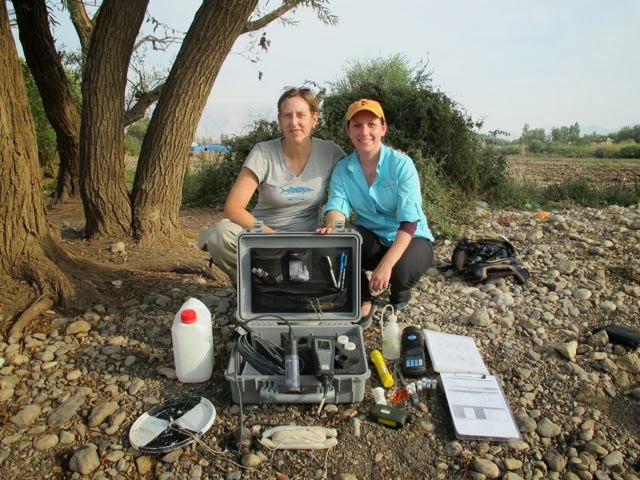
Attached below is a photo from our survey work in Kurdistan, Northern Iraq this winter. The folks in the background are part of our water quality survey team.

Thursday, January 01, 2009

I wanted to spread the word about this press release from the Free Gaza Movement. I was told about this project to take boats with humanitarian aid supplies to Gaza by Kathy Kelly, the Chicago-based peace activist that was a founder of Voices in the Wilderness (the peace organization that arranged for my first trip to Iraq as part of a Iraq Peace Team delegation). She asked me if I was interested in the project and I immediately started doing some research about the coastal waters off Gaza. I never ended up going (I remember my boss saying, "No way" when I asked about getting time off to do it). To bad, anything involving boats, water and peace always gets my attention. Anyway, the project did get off the ground and there have been several successful trips to Gaza ... until this event only a few days ago.

FOR IMMEDIATE RELEASE Date : 12-30-2008
For more information, please contact:(Gaza) Ewa Jasiewicz, +972 598 700 497 / freelance@mailworks.org(Cyprus)
Lubna Masarwa +357 99 081 767 / lubnna@gmail.com(Lebanon)
Caoimhe Butterley +961 70 875 727 / sahara78@hotmail.co.ukhttp://www.freegaza.org/

Israeli Gunboats Came Out of the Darkness and Rammed Us Three Times

(Lebanon, Tuesday 30 December) - Today the Free Gaza ship Dignity carefully made its way to safe harbor in Tyre, Lebanon's southern-most port city, after receiving serious structural damage when Israeli warships rammed its bow and the port side. Waiting to greet the passengers and crew were thousands of Lebanese who came out to show their solidarity with this attempt to deliver volunteer doctors and desperately needed medical supplies to war-ravaged Gaza. The Lebanese government has pledged to provide a forensic analysis of what happened in the dark morning, when Israel rammed the civilian ship in international waters, and put the people on board in danger of losing their lives.

The Dignity, on a mission of mercy to besieged Gaza, was attacked by the Israeli Navy at approximately 6 am (UST) in international waters, roughly 90 miles off the coast of Gaza. Several Israeli warships surrounded the small, human rights boat, firing live ammunition around it, then intentionally ramming it three times. According to ship's captain Denis Healy, the Israeli attack came, ""without any warning, or any provocation."

Caoimhe Butterly, an organizer with the Free Gaza Movement, stated that, "The gunboats gave us no warning. They came up out of the darkness firing flares and flashing huge flood lights into our faces. We were so shocked that at first we didn't react. We knew we were well within international waters and supposedly safe from attack. They rammed us three times, hitting the side of the boat hard. We began taking on water and, for a few minutes, we all feared for our lives. After they rammed us, they started screaming at us as we were frantically getting the life boats ready and putting on our life jackets. They kept yelling that if we didn't turn back they would shoot us."

Cynthia McKinney, former U.S. congresswoman and Green Party presidential candidate, was traveling to Gaza aboard the Dignity in order to assess the impact of Israel's military onslaught against the civilian population of the Gaza Strip. According to McKinney, "Israeli patrol boats...tracked us for about 30 minutes...and then all of a sudden they rammed us approximately three times, twice in the front and once in the side...the Israelis indicated that [they felt] we were involved in terrorist activities."

The Dignity departed from Larnaca Port in Cyprus at 7pm (UST) on Monday 29 December with a cargo of over 3 tons of desperately needed medical supplies donated to Gaza by the people of Cyprus. Three surgeons were also aboard, traveling to Gaza to volunteer in overwhelmed hospitals and clinics. The ship was searched by Cypriot Port authorities prior to departure, and its passenger list was made public.

Israel's deplorable attack on the unarmed Dignity is a violation of both international maritime law and the UN Convention on the Law of the Sea, which states that "the high seas should be reserved for peaceful purposes."

Delivering doctors and urgently needed medical supplies to civilians is just such a "peaceful purpose." Deliberately ramming a mercy ship and endangering its passengers is an act of terrorism.

CALL the Israeli Government and demand that it immediately STOP attacking the civilian population of Gaza and STOP using violence to prevent human rights and humanitarian assistance to the Palestinian people.

Mark Regev in the Prime Minister's office at:+972 2670 5354 or +972 5 0620 3264
mailto:3264mark.regev@it.pmo.gov.il

Shlomo Dror in the Ministry of Defence at:+972 3697 5339 or +972 50629 8148
mailto:8148mediasar@mod.gov.il

Major Liebovitz from the Israeli Navy at:+ 972 5 781 86248

###

The Free Gaza Movement, a human rights group, sent two boats to Gaza in August 2008. These were the first international boats to land in the port in 41 years. Since August, four more voyages were successful, taking Parliamentarians, human rights workers, and other dignitaries to witness the effects of Israel's draconian policies on the civilians of Gaza.

http://www.freegaza.org/

Tuesday, December 23, 2008

Not many know that there is almost constant bombing going on by the Turkish army targetting simple villagers in northern Iraq. Here is the latest from the Christian Peacemaker Team on the issue:

CPTnet - 8 December 2008
IRAQ: CPTers visit northern villages under siege.

On 28 November, the Christian Peacemaker Team in Iraq traveled to the village of Hardan and met some of the 450 families from villages displaced by Turkish bombs. The people recounted the Baath regime’s backlash against the 1991 Kurdish uprising, which displaced many of them. They returned in 1992 and rebuilt their villages without assistance. Then in 1995, Turkey bombed them for the first time, and they all fled together.

The families spent two years in tents before an NGO provided each one with six hundred blocks and ten cement bags. The years 2003-07 were quiet. New roads and bridges were built and people were able to return to their home villages to farm and make a living. But in February 2008, Turkey bombed their homes again with the help of U.S. military intelligence and destroyed bridges to prevent people from accessing their crops. Villagers told CPTers, “Life is very hard here because we have no income.” Continuous bombing in the area of the Korazhar Mountains forced the people of 400 villages to flee. CPT heard and saw reconnaissance planes while in Hardan.

The team passed several abandoned villages on their way to one called Trwanish where they met an uncle and his nephew harvesting apples next to the ruins of a school. Both had lived there and told how their village has suffered multiple attacks by the previous regime and Turkey. At least ten people died there in 1998 and orchards were burned three times. Nearby were rows and rows of houses built by the government in the mid-nineties. Two thousand people once inhabited them but all but a few had left because of recent violence. A Turkish military base sits on a hill close by and CPTers learned that whenever people begin to move back or harvest the attacks start.

At the end of their visit, CPTers came to a bridge near the border, beyond which fourteen villages lie empty. Over the hill was Turkish artillery. Local security told CPTers that even in the midst of ongoing fighting some people return in the spring to tend to the land.

Tuesday, December 16, 2008

Where is the Iraqi Shoe-thrower, Muntadar Al Iraqi (formerly Al Zaidi)?

After calling President Bush a dog and throwing both shoes at him, Muntadar al-Zaidi, the Iraqi journalist who works for Baghdadiya News, may have gone missing. I hope he's ok.

In an article yesterday on the BBC website, Muntadar's bureau chief stated, "I
am trying to reach Muntadar since the incident, but in vain. His phone is
switched off" (Read the article dated 01:02 GMT, Monday, 15 December 2008).

The Iraqi power structure is often democratic in name only and they view his actions as an embarrassment. Even though the people in power opposed Saddam they were also raised in his world and tend to operate the same way he did. Yet Muntadar's actions brought a smile to many a face here and abroad ... and prompted a chortling email from my family members who got a kick out of seeing our President come face to face (face to shoe anyway) with someone who had the courage to speak honestly about a death and destruction of the war in Iraq. This is, afterall, a topic that Bush never fails to ignore, but for which he must be held accountable. If for nothing else then pure and simple hubris.

Here is another article on the current status of Muntadar.

Wednesday, November 26, 2008

The Art of Apology

A wise friend once told me that when in doubt, apologize. No matter where the fault is, apologize --- sincerely and without qualification (no, "I'm sorry for what I did, but ..."). Even if you believe you aren't to blame (most likely you are wrong about that anyway) just apologize. It will open all the doors and overcome all resistance. Apology, in short, if done right, is disarming.

Certainly it can be a challenge to eat crow in this way, especially when all your emotions are screaming, "but I didn't do anything wrong!" It doesn't matter, my friend said, just apologize. I've tried to follow my friends guidance as much as I could and haven't regretted it though I've been known to choke on an apology once or twice myself.

I try not to paint people with too broad a brush but if there were ever a people who collectively could benefit from learning this art of apology it is Iraqis. For some reason they equate it with losing face or honor. They can't admit to their mistakes - they must throw the blame on someone else or make even the most outlandish excuses to avoid admitting that they were wrong. Perhaps lies are easier to say than apologies.

A friend in Sulaimani told me that though this is generally true, people here will actually apologize for silly things that they don't need to ... particularly to a superior. Perhaps it is a way of ingratiating yourself with the boss, for example. But apologies to a colleague of equal or "lesser standing" are unthinkable for some reason.

I have seen this play out again and again - and it is really quite tragic. You wonder at the pain it must have caused and all the problems that might have been avoided if people had simply learned to apologize to each other. I've seen co-workers here brought to a fever-pitch of anger, instilling long-term vendettas against one another over things that a simple apology might have resolved in moments. But it was always pride or some false sense of righteousness that gets in their way.

In the face of this I wonder what I can do to try and help. Provide some positive role model? Play some kind of peacekeeper/peacemaker? Once, when an Iraqi friend here hurt me, he never apologized, so I hurt him back. So who am I to play the peacemaker? I'm still trying to learn the art of apology myself.

Friday, November 21, 2008

Mongo Pomegranates Appear in Sulaimani

Over the last year a new phenomenon has appeared in the city of Sulaimani. Huge apples and pomegranates have been showing up all over the city ... as if dropped from some celestial tree. They are all basically the same size and shape and made out of some cement-type material (as is everything in Iraq these days).

I first spotted them on the airport road into town ... dotting the median strip ... a big green apple and a bright red pomegranate. They were a welcome sight in a landscape that often appears like a cross between a lunar landscape and a, I'm sorry to say, garbage dump. Aleast someone put some effort into making a piece of art and, I thought, a pretty good one.

But then dozens showed up in Park Azadi (the local park down the street where I run in the morning) but these appeared more like poor production copies and had convenient seat-shaped chunks cut out of them ... showing the bright red, pulpy seeds (these are, in case you wanted to know, called arils in a pomegranate) ... at least until you get up close to examine the paint job.

Then one day I stumbled on the mother-load ... in a building behind the passport office (where I had to renew my residence in a curiously Kafkaesque procedure requiring running around between half a dozen offices filled with tea-inebriated civil servants). There I spied over a dozen of these massive fruits (all essentially identical in size and shape but painted to represent the different types of fruit ... there were even a few painted as watermelons). They were lined up like little soldiers about to march off into the city streets. No doubt to make the place safe for civic arts in Kurdistan-Iraq (and just when I was celebrating the removal of that god-awfully misshapen statue at the entrance to town showing a kneeling woman breaking the chains that bound her hands ... it was removed for a road construction project ... my apologies to the artist but it looked like it had been created by a class of kindergarten students).

Well, art is in the eye of the beholder and I'm happy to see an effort but I find myself wishing that the people here could see the beauty that they have covered up in garbage or spent time hiding under stupidly-conceived cement monstrosities. I wish they could find a way to simply uncover and protect that. Sulaimani might then be a real work of art.

Thursday, November 06, 2008

Surrounded by Iraqi 'Republicans'

So we are about to have a new president named Barak Hussein Obama. The first African-American president for the United States. I'm excited at the prospect. I left the country in disgust when Bush was re-elected for his second term. All my life, having grown up in a family of democrats (well, my Dad says he is a republican, but only so he can vote in the primaries against 'the crazies' of the party) and worked for lefty organizations (environment & workers' rights), I haven't really known too many folks that supported the Reagans, Bushes and McCains of this world.

Some members of my family consider that now that we live in the time of Guantanamo and Abu Ghraib, that the republican party is the party that stands for torture and lies (you know, about things like weapons of mass distruction and other reasons for going to war against foreign nations ... little stuff like that). But now I live in Kurdistan, northern Iraq and I'm surrounded by McCain supporters. I kind of get where the Kurds are coming from (to them, Bush was the great liberator). I was arguing with our logistics guy about it yesterday (in a cross between kurdish, arabic, english and sign language) ... he felt that Bush had been and McCain would be stronger on terrorism than Obama. I felt the republican crowd has actually done a piss poor job of handling terrorism and have ignored the roots from which is springs, ensuring a perpetual cycle of violence.

But even some of the Iraqi Arabs I work with are worried and some that carried American passports and could vote in the election supported McCain if only on the one issue of Iraq and their worry that America will withdraw under Obama.

For sure, I tend to agree that an abrupt pull out would be quite problematic for Iraq, but neither do I agree that the sky will necessarily fall. People are worried that Iran will come to fill the vacumn and that this will have terrible consequences for the region. Perhaps, but as weak as the country is when compared to its neighbor, Iraq still has a strong nationalistic sense and if it didn't want to be controlled by the U.S. I believe the same will hold true where Iran is concerned. Despite the strong ties that link the two countries, I hope that Iraq can hold its own course regardless of the shifting winds in Washington.

Monday, October 27, 2008

Two standards?

One of the staff (my roommate - a woman and one of the few who work for us) went home for the weekend to Baghdad and everyone seemed to blow a gasket. Emails are flying about, mobiles are ringing, people are wringing their hands, talk of firing the woman was in the air. I honestly didn't understand what all the commotion was about. She had spent the week, along with the other staff, working late and almost the entire staff was leaving for a conference, so she wanted to go home because she didn't want to stay by herself (not such an uncommon feeling for a young arab woman away from family and friends). She had recently been away for a three month leave and so was told she needed to be at work as there were some problems that needed to be dealt with at the lab and it was unfair to give her additional leave when no one else was getting it.

So ok, she has to be at work, but surely her weekends are still hers are they not? And if she is adult enough and daring enough to live by herself for a week (something that most Iraqi women would have difficulty with), then surely its her decision as to what to do with her time off.

For curtesy and for safety she should tell people what her plans are (this she did, though not to her direct supervisor, which would have been preferable .... ok, so there is a handslap for you, young lady) and she should find the safest way to travel (she used a driver she knew).

If she reports back to work on time for the start of the week ... what is the big deal? Ah, she was late! Three hours late because her driver could not leave when she wanted him to. Ah well, atleast send a message saying you'll be late, my dear. But I'm told she did not do this though when I asked her about it she told me she had sent messages to both the office manager and her immediate supervisor to warn them she'd be late.

Honestly, I'm not sure who to believe but I find myself just shaking my head about this stuff. We have so few women who work for us and more and more, as we seek international funding, we need to show that we offer equal opportunities for women ... but in a place like Iraq, where women do not have the freedom of men that's a tall order. You have to get the work done and often the easy way out is to get a guy to do the job. I sometimes feel that the managers, atleast unconsciously, would rather not deal with all the problems that result from having women work for us ... its tiring even for me. I came here to work on problems related to the environment not deal with silly interpersonnel problems between the men and women.

But for the women who left their families and support network to come up from Baghdad to work for us, it is important to remember that they took alot of risks. They were doing something out of the ordinary and they faced criticism for it. They and the men they worked with behaved badly at times with each other. Mostly because they were in a new relationship with one another and they didn't know what proper behavior was. They were just ignorant. Not malicious.

And I would say that the same was true of the management ... for, despite their intellectual understanding of the problems that women face here, in the end they seem to hold the women to two different and conflicting standards ... a traditional standard as dependent females who must be controlled and a more western standard as employees who can work and live under any conditions that management dictates.

In the end, I just see that the men in the office continue to advance and benefit from the work they do with us and the women continue to struggle ... one has been fired and the other is on the brink of losing her job for going home on her weekend.

Women who have been treated as children their whole lives and the men who have been taught to patronize and dominate these same women are going to have a long and difficult path to creating a more open and free society. I, as an outsider and mostly a spectator (but occasional participant in this whole mess), can attest in some small way to how painful that path can be.